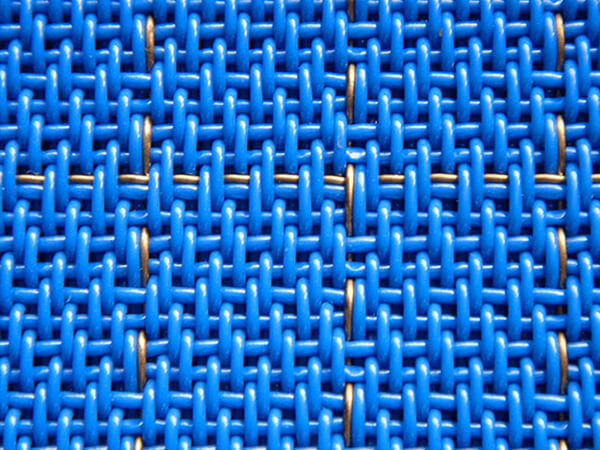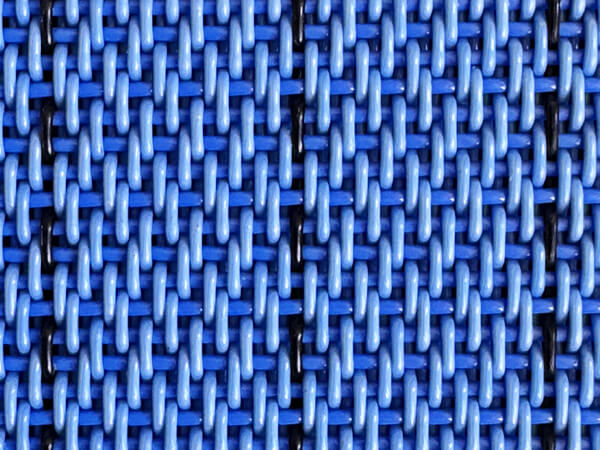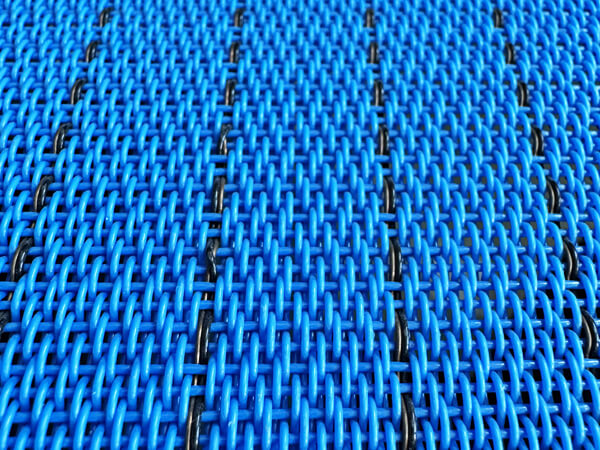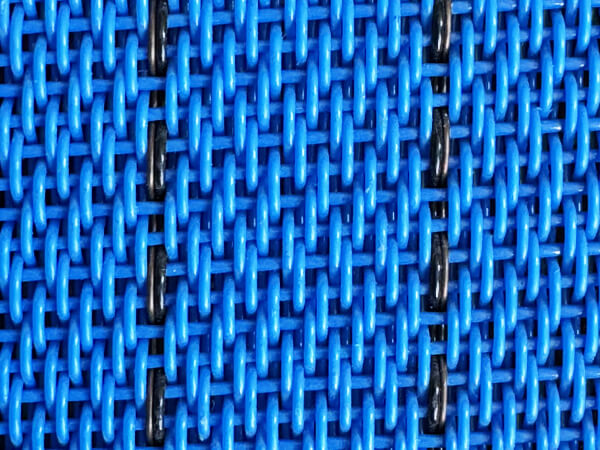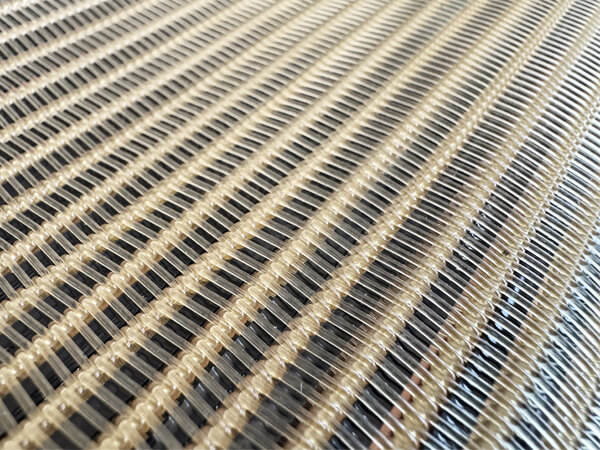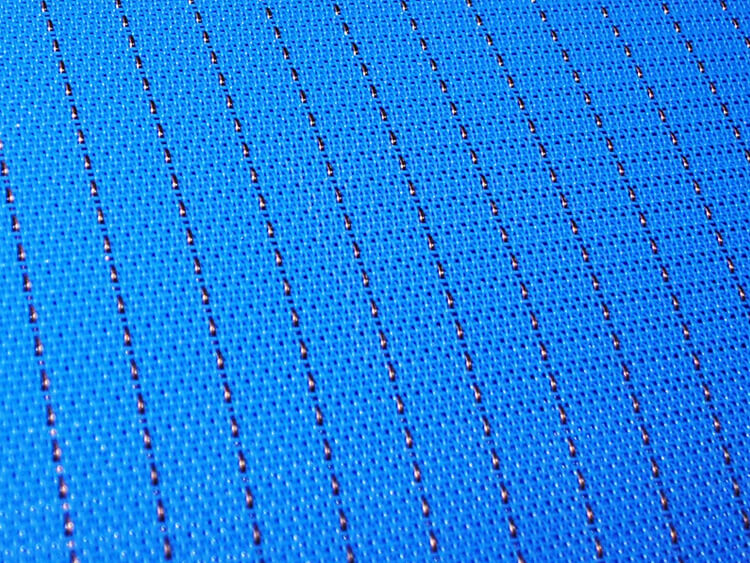
PFM Screen's pre-press ventilation belts eliminate air pockets from fiber and chip mats in MDF, HDF, PB, and OSB continuous pre-press systems — without lateral mat displacement. Permanently antistatic via woven copper or carbon conductive threads (ATEX-certified). Air permeability: 6,800 m³/m²/h (430 L/m²/s at 200 Pa). Warp tensile strength: 2,000 N/cm. Available to 8,000 mm width with four on-site splice options for rapid changeover.
Description
PFM Screen's Pre-press and Ventilation Belts — also known as de-airing belts or deaeration belts — are precision-woven polyester monofilament mesh belts engineered for the pre-press stage of MDF, HDF, particleboard (PB), and OSB continuous production lines. During pre-pressing, the spread fiber mat or chip mat is compressed between the upper and lower belts to reduce mat thickness and expel trapped air before the mat enters the main heated continuous press. PFM Screen's open-mesh belt structure allows air to escape uniformly through the fabric while the stable interlocked weave supports the mat and prevents lateral chip or fiber displacement — a critical requirement for achieving uniform panel density and eliminating edge defects.
What distinguishes PFM Screen's ventilation belt from standard mesh belts is the permanently antistatic construction: copper threads, carbon threads, or a dual copper+carbon combination are woven directly into the polyester monofilament warp at weaving — not applied as a surface coating. This creates a continuous electrostatic discharge path that remains fully effective for the belt's entire service life, regardless of washing or abrasion, and complies with ATEX explosion protection standards for wood-dust Zone 21 and Zone 22 environments.
In continuous MDF and particleboard production, the fiber mat or chip mat as it leaves the forming station may contain up to 60–80% air by volume. If this air is not systematically expelled before the main press, the consequences are severe:
01 Surface Blistering Trapped air expands under press heat and pressure — forming surface blisters and internal delamination that cause panel rejection | 02 Spring-Back Effect Incompletely de-aired mats expand ("spring back") as they exit the pre-press, disrupting mat transfer into the main press infeed | 03 Density Variation Non-uniform air expulsion creates density gradients across the panel face — raising sanding allowance and downgrade rates | 04 Dust Explosion Risk Static charge on non-antistatic belts in wood-dust zones can ignite suspended particles — an ATEX Directive compliance failure |
PFM Screen offers three conductive thread configurations — all delivering ATEX-compliant permanent electrostatic discharge. Select by process environment and zone classification:
Model 14804K — Copper Thread ● Highest conductivity path — fastest discharge ● Standard choice for MDF and particleboard lines ● Excellent resistance to resin adhesive residues ● ATEX Zone 21/22 compliant | Model 14804T — Carbon Thread ● Low-profile thread — minimal visual marking on mat face ● Higher inherent abrasion resistance in some environments ● Suitable for OSB and HDF applications ● ATEX Zone 21/22 compliant | Model 14804M — Copper & Carbon ● Dual-thread construction — maximum discharge redundancy ● For high-speed lines and stricter zone classifications ● Recommended for OSB strand and high-dust environments ● ATEX Zone 21/22 compliant |
* All three models share identical mechanical and airflow specifications. Thread selection is a process and zone-classification decision — contact PFM Screen engineering for a recommendation based on your ATEX assessment.
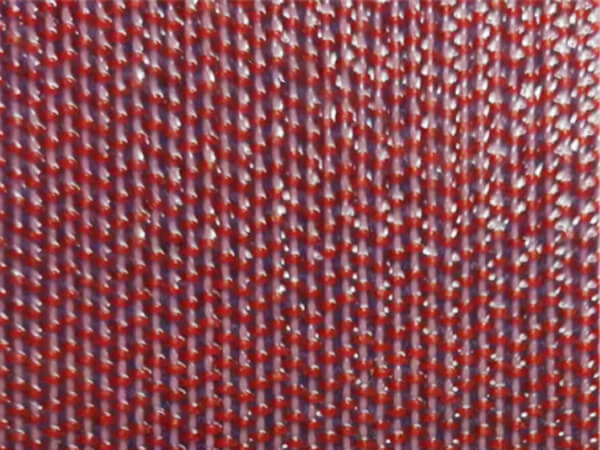
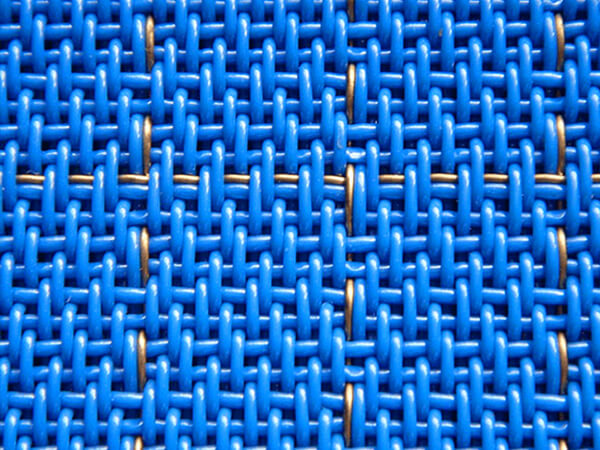 Open-mesh woven polyester structure with interlocked monofilament warp and weft | 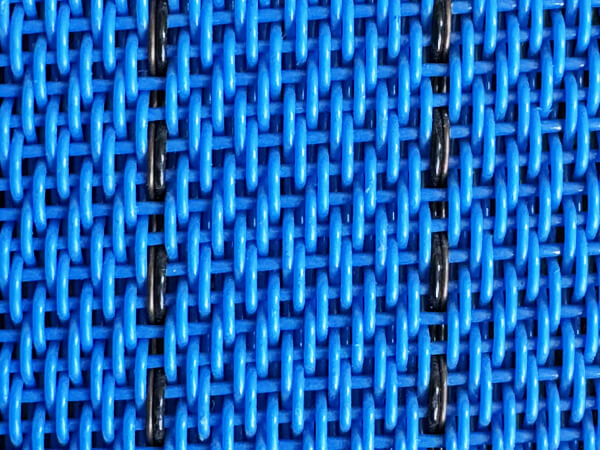 Belt produced in continuous rolls and cut to exact press width | 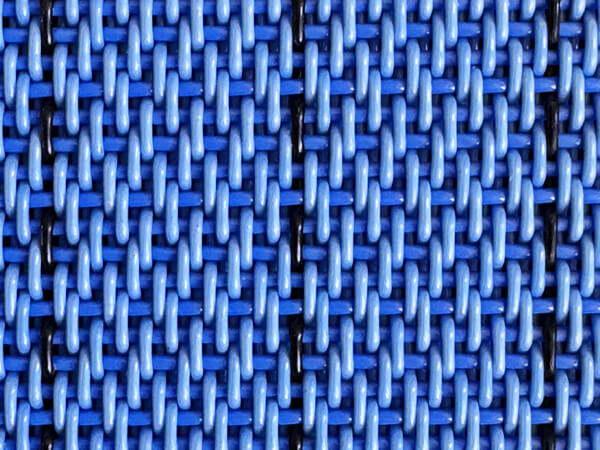 Conductive copper or carbon threads woven permanently into polyester warp |
Custom Width to Press Specification PFM Screen manufactures pre-press ventilation belts to any width from standard industrial sizes up to 8,000 mm — matching the exact pre-press station width of your continuous production line. Provide your press model and belt width for confirmed engineering. | Mesh Size Matched to Wood Material Aperture and open area are engineered to the specific wood material being processed — finer mesh for MDF fiber mats (smaller fiber geometry), coarser aperture for particleboard chip mats and OSB strand mats where larger particle support is required. |
Four Splice Options Endless Woven, Stainless Steel Fastener, Plastic Pin-seam, and Finger Splice Prepared — covering all installation scenarios from planned factory fitting to rapid on-site belt replacement during maintenance windows. | Stable Sealed-Edge Construction Sealed belt edges prevent chip and fiber particles from infiltrating the belt edge zone. Stable woven structure maintains dimensional consistency under sustained pre-press tension, eliminating lateral drift and mat displacement over long production runs. |
Get a Custom Belt Specification Within 24 Hours Share your press model, required belt width, panel type (MDF/HDF/PB/OSB), and preferred splice method — PFM Screen will engineer the correct belt for your line. WhatsApp: +86 153 6967 9157Email: polyestermesh@pfmscreen.com |
Feature
2000 N/cm Warp Strength High warp tensile strength sustains belt integrity under pre-press roller load without elongation or tracking drift | 6800 m³/m²/h Airflow 430 L/m²/s at 200 Pa — high and controlled air permeability ensures rapid, uniform deaeration without mat surface disruption | ATEX Antistatic Certified Woven-in copper/carbon threads provide permanent electrostatic discharge compliant with ATEX Directive for wood-dust explosive atmospheres | 8000 mm Max Width Covers the full range of continuous pre-press station widths — custom cut to exact press specification for any MDF, HDF, PB, or OSB line |
Permanently Antistatic — Woven-In Conductive Threads Copper threads (14804K), carbon threads (14804T), or dual copper+carbon (14804M) are woven directly into the belt warp at the time of manufacture — not applied as a topical coating. The discharge path cannot wash off, abrade away, or degrade over service life. ATEX-compliant for wood-dust Zone 21 and Zone 22 environments under Directive 2014/34/EU. | Stable Fabric Structure — Prevents Lateral Mat Displacement The interlocked polyester monofilament warp and weft create a dimensionally stable fabric that resists lateral deformation under pre-press load. Chip or fiber particles cannot penetrate the belt body. Sealed edges prevent mat material from escaping laterally around belt edges — maintaining uniform mat width from pre-press entry to main press infeed. |
High Chemical Resistance Polyester monofilament withstands adhesive resins (UF, MF, MDI/pMDI, PF) and release agents present in MDF and particleboard production. Resists chemical build-up that causes belt surface sticking and mat adhesion. Minimal cleaning maintenance required — routine spray-down with water is sufficient in most applications. | High Abrasion Resistance — Extended Service Life Strong polyester monofilament (0.68 mm warp / 0.8 mm weft wire diameter) delivers extended service life under the continuous mechanical stress of pre-press roller contact. High elongation modulus maintains belt dimensions under sustained tension — preventing stretch-induced tracking problems and eliminating the belt replacement frequency caused by premature elongation. |
| Splice Type | Description | Best For | Installation Speed |
|---|---|---|---|
| Endless Woven | Seamless woven belt — no hardware, no joint | Maximum mat surface uniformity — eliminates joint-mark imprint on mat face | Factory installation only |
| Stainless Steel Fastener | Flat or round metal clips on belt ends | High-tension continuous pre-press lines; standard for most MDF/PB plants | Fast on-site installation |
| Plastic Pin-seam | Plastic pin-and-loop connector system | Environments with chemical exposure; corrosion-sensitive systems | Fast on-site installation |
| Finger Splice Prepared | Belt ends prepared for on-site woven finger splice | Minimal production interruption; strong joint approaching endless performance | Moderate on-site time; specialist tool required |
Improved Top-Layer Density Efficient, uniform deaeration through the belt surface builds controlled density in the mat face layer before the main press. This reduces the sanding allowance required on the finished panel surface — directly lowering sanding waste and abrasive consumption costs. | Higher Line Speed Capability A belt with consistently high and uniform air permeability allows the pre-press to operate at higher line speeds without incomplete deaeration. PFM Screen's 6,800 m³/m²/h airflow rate provides headroom for production throughput increases without belt-related quality compromises. |
Eliminates Spring-Back Before Main Press Thorough pre-compression and deaeration stabilizes the mat structure so that spring-back is minimized as the mat exits the pre-press station. This ensures accurate mat thickness entry into the main press infeed — critical for maintaining panel thickness tolerance and reducing press cycle variation. | Reduced Belt Maintenance Intervals The chemical resistance of PFM Screen's polyester monofilament prevents adhesive and resin accumulation on the belt face. Clean-belt performance is maintained with minimal spray-down intervals — reducing line stoppages for belt cleaning and extending the time between belt replacements compared to lower-grade fabrics. |
Ready to Order? Get Your Custom Quote Within 24 Hours Share your belt width, panel type, conductive thread preference, and splice method — PFM Screen will return full specifications and pricing within one business day. WhatsApp: +86 153 6967 9157Email: polyestermesh@pfmscreen.com |
Application
In a continuous MDF, HDF, or particleboard production line, the pre-press ventilation belt operates between the mat forming station and the main continuous hot press. This is one of the most mechanically demanding positions on the line — the belt runs under sustained compression load while simultaneously allowing high-volume airflow through its structure to deaerate the mat.
| Wood Chip / Fiber Drying | → | Mat Forming Station | → | PRE-PRESS ZONE PFM Ventilation Belt | → | Main Continuous Hot Press | → | Cooling / Sanding / Cutting |
* In some line configurations, the ventilation belt also runs in the pre-steam zone immediately upstream of the continuous press infeed. Contact PFM Screen for specific position engineering.
MDF — Medium Density Fiberboard ● Fine fiber mat — requires controlled, uniform airflow to deaerate without surface disruption ● UF resin systems — belt must resist adhesive pick-up and fiber adhesion ● Standard application for Model 14804K (copper thread) ● Target: no blister, no delamination, controlled top-layer density | HDF — High Density Fiberboard ● Higher compression than MDF — belt must sustain greater pre-press load ● Thinner mat — deaeration speed critical to prevent mat disruption at high line speeds ● Suitable for both 14804K and 14804T models ● Flooring substrate production: demands superior surface smoothness at mat face |
PB — Particleboard (Chipboard) ● Chip mat — larger particles require wider mesh aperture vs. MDF fiber mat ● Higher mat volume before pre-press — deaeration capacity is critical ● UF and MDI resin systems — chemical resistance essential ● Standard application for Model 14804K; dustier environments suit 14804M dual-thread | OSB — Oriented Strand Board ● Large strand mat — requires coarser mesh aperture for strand geometry support ● pMDI/MDI resin — high chemical resistance requirement ● High-dust, high-static environment — Model 14804M dual copper+carbon recommended ● Wide-belt lines up to 8,000 mm — PFM engineers to exact OSB press width |
PFM Screen pre-press ventilation belts are custom-engineered to match the exact width, tension, and material specifications of major continuous pre-press stations worldwide. The following systems are commonly served:
| Press Manufacturer | System / Product Line | Typical Panel Applications | Typical Belt Width Range |
|---|---|---|---|
| Siempelkamp | ContiRoll, SicoPress — continuous pre-press station | MDF, HDF, PB, OSB | 2500–8000 mm |
| Dieffenbacher | CPS+, EVO continuous press — pre-press module | MDF, PB, OSB | 2500–8000 mm |
| IMAL-PAL Group | Pre-press and mat forming systems | PB, MDF, HDF | 2000–7000 mm |
| Chinese Domestic | Domestic continuous press systems (various) | MDF, PB, HDF | 1500–6000 mm |
* PFM Screen engineers belts to the exact width and tension requirements of any pre-press system. Provide your press model and belt dimensions for a confirmed specification. Brand names are referenced for compatibility guidance only.
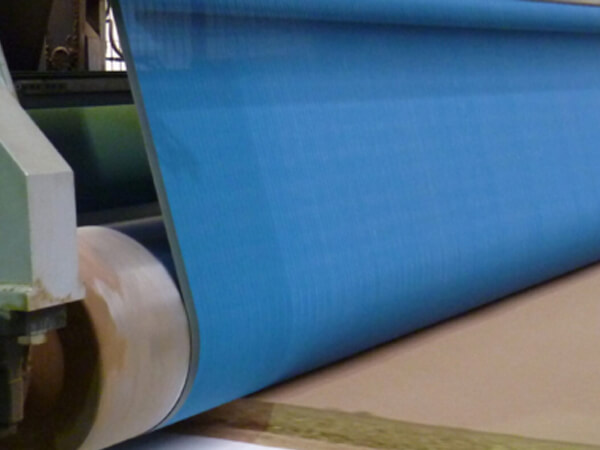 Pre-press ventilation belt in continuous MDF production line application | 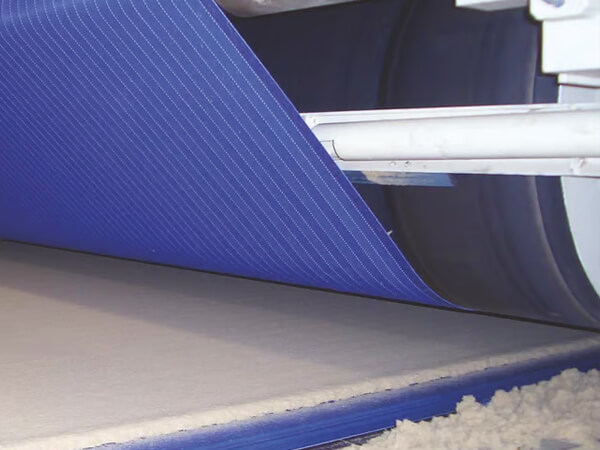 Particleboard pre-press zone operation — belt provides uniform deaeration under roller compression |
Industries and Panel Types Served by PFM Screen Pre-press Ventilation Belts MDF ManufacturingHDF ProductionParticleboard (PB)OSB ManufacturingWood Fiber Insulation BoardContinuous Pre-press Systems |
Discuss Your Pre-press Line Requirement Tell us your press system, panel type, and belt width — PFM Screen will confirm the correct model and issue a quotation within 24 hours. WhatsApp: +86 153 6967 9157Email: polyestermesh@pfmscreen.com |
Specifications
Three standard models available — 14804K, 14804T, and 14804M — differentiated by conductive thread type for ATEX compliance. All models share identical mechanical and airflow specifications. Standard warp tensile strength: 2,000 N/cm. Weft tensile strength: 900 N/cm. Air permeability: 6,800 m³/m²/h (430 L/m²/s at 200 Pa). Maximum delivery width: 8,000 mm. Custom belt widths and mesh configurations available on request.
| Model | Wire Diameter (mm) | Density (wire/cm) | Tensile Strength (N/cm) | Conductive Thread | Thickness (mm) | Air Perm (m³/m²/h) | Air Perm L/m²/s (200 Pa) | |||
|---|---|---|---|---|---|---|---|---|---|---|
| Warp | Weft | Warp | Weft | Warp | Weft | |||||
| 14804K | 0.68 | 0.8 | 14.8 | 7.2 | 2000 | 900 | Copper | 1.95 | 6800 | 430 |
| 14804T | 0.68 | 0.8 | 14.8 | 7.2 | 2000 | 900 | Carbon | 1.95 | 6800 | 430 |
| 14804M | 0.68 | 0.8 | 14.8 | 7.2 | 2000 | 900 | Copper & Carbon | 1.95 | 6800 | 430 |
* Custom belt widths up to 8,000 mm and beyond available on request. Custom mesh specifications (different wire diameter, density, or aperture) for OSB strand mats or other wood materials available. Contact PFM Screen with your specific process requirements for a custom engineering proposal.
| Model | Thread Type | ATEX Compliance | Recommended For |
|---|---|---|---|
| 14804K | Copper thread woven into warp | Zone 21 / Zone 22 | Standard MDF, HDF, particleboard — most common selection |
| 14804T | Carbon thread woven into warp | Zone 21 / Zone 22 | Applications where low belt-face thread visibility is required; HDF, OSB |
| 14804M | Copper + Carbon threads woven into warp | Zone 21 / Zone 22 (enhanced reliability) | High-speed OSB and high-dust environments; facilities with stricter ATEX zone assessment |
Q1: What is a pre-press ventilation belt and how does it work in MDF and particleboard production? A pre-press ventilation belt — also called a de-airing belt or deaeration belt — is a permeable woven mesh belt used in the pre-press section of MDF, HDF, particleboard (PB), and OSB continuous production lines. The spread fiber mat or chip mat leaving the forming station can contain up to 60–80% air by volume. During pre-pressing, the mat is compressed between upper and lower belts under roller load, and the belt's open-mesh structure allows this trapped air to escape uniformly through the fabric before the mat enters the main heated continuous press. Proper deaeration prevents surface blistering, delamination, density variation, and the spring-back effect that disrupts mat transfer into the main press infeed. |
Q2: Why is permanent antistatic performance essential in a pre-press ventilation belt? In MDF and particleboard pre-press environments, fine wood dust and fibers are continuously airborne — creating an explosive atmosphere (ATEX Zone 21 or 22) where electrostatic build-up on a belt surface can ignite suspended particles. Static charge also causes chip and fiber adhesion to the belt face, producing mat defects and creating cleaning downtime. PFM Screen achieves permanent antistatic performance by weaving copper threads, carbon threads, or both directly into the polyester warp structure at the time of manufacture — not as a topical coating. This permanent discharge path cannot wash off, abrade away, or degrade over service life, ensuring continuous ATEX compliance for the belt's full working life. |
Q3: What is the difference between the 14804K (copper), 14804T (carbon), and 14804M (copper+carbon) models? All three models achieve ATEX-compliant electrostatic discharge with identical mechanical and airflow specifications: 2,000 N/cm warp tensile strength, 900 N/cm weft tensile strength, 6,800 m³/m²/h air permeability (430 L/m²/s at 200 Pa), and 1.95 mm thickness. The selection depends on process and zone-classification requirements: the 14804K copper thread model provides the most conductive discharge path and is the standard choice for most MDF and particleboard lines; the 14804T carbon thread model offers a lower-profile thread with less visual marking on the mat surface face, suitable for HDF and OSB; the 14804M dual copper+carbon model provides maximum discharge redundancy for high-speed OSB lines, high-dust environments, or facilities where ATEX assessment requires enhanced antistatic reliability. |
Q4: What is the maximum belt width and can PFM Screen produce non-standard widths for any continuous press system? PFM Screen manufactures pre-press ventilation belts to a standard maximum delivery width of 8,000 mm — covering the full range of industrial MDF, HDF, PB, and OSB continuous pre-press systems from all major press manufacturers. Belts are supplied to the buyer's exact press width specification, in endless (seamless) or mechanical-join configurations. For systems with non-standard or unusual widths, or where the belt must span multiple pre-press roller sets, contact PFM Screen engineering with your press model, required belt width, and operating tension for a custom engineering proposal and confirmed lead time. |
Q5: Which continuous pre-press systems are PFM Screen's ventilation belts compatible with? PFM Screen's pre-press ventilation belts are custom-engineered to match the exact width, tension requirements, and operating conditions of major continuous pre-press systems including Siempelkamp ContiRoll and SicoPress stations, Dieffenbacher CPS+ and EVO pre-press modules, IMAL-PAL group systems, and domestic Chinese continuous press lines. The belt's 2,000 N/cm warp tensile strength and high elongation modulus ensure consistent tracking and pre-compression performance across all continuous pre-press geometries. Provide your press manufacturer, model, and belt width to PFM Screen for a confirmed fit recommendation. |
Q6: What splice methods are available and which is best for minimizing production downtime? PFM Screen offers four splice options for pre-press ventilation belts: (1) Endless Woven — a fully seamless belt with no hardware, preferred where mat surface uniformity is critical as no joint-mark is imprinted on the mat face; (2) Stainless Steel Fastener — flat or round metal clips providing fast on-site installation for high-tension continuous pre-press systems, the standard choice for most MDF and PB plants; (3) Plastic Pin-seam — a corrosion-resistant connector for chemical-exposure environments or where metal fasteners are not permitted; (4) Finger Splice Prepared — belt ends are pre-formed for on-site woven finger splice joining, delivering a strong joint approaching endless performance with fast installation. For most planned maintenance belt changes, the Stainless Steel Fastener option offers the fastest changeover. For maximum mat surface quality, the Endless Woven option is recommended. |
Q7: How does PFM Screen's pre-press belt prevent lateral displacement of the fiber mat or chip mat? Lateral mat displacement during pre-pressing causes edge defects, chip loss, and non-uniform panel density — leading to increased downgrade rates and sanding waste. PFM Screen's pre-press ventilation belt prevents this through three design elements: (1) a dimensionally stable interlocked monofilament warp and weft structure that maintains belt geometry under pre-press roller compression without deforming laterally; (2) mesh aperture engineered to the specific fiber or chip geometry of the material being processed, providing sufficient airflow while supporting the mat surface without creating gaps through which particles can escape; and (3) sealed belt edges that prevent mat particles from infiltrating the belt edge zone and displacing laterally around belt edges — maintaining consistent mat width from pre-press entry through to main press infeed. |
Q8: What is the minimum order quantity and lead time for custom pre-press ventilation belts? PFM Screen accepts orders from a single replacement belt to full production supply contracts — there is no fixed minimum order quantity. Standard lead time for custom-engineered pre-press ventilation belts is typically 3 to 5 weeks after belt width and splice configuration confirmation, depending on belt size, model selection, and production scheduling. Rush orders can be accommodated in certain cases. Contact our team via WhatsApp (+86 153 6967 9157) or email (polyestermesh@pfmscreen.com) with your press model, required width, panel type, and preferred splice method for a formal quotation within 24 hours. |
Ready to Order? Get Your Custom Quote Within 24 Hours Send us your press model, belt width, panel type (MDF/HDF/PB/OSB), conductive thread model, and splice method — PFM Screen will respond with full specifications and pricing within one business day. WhatsApp: +86 153 6967 9157Email: polyestermesh@pfmscreen.com |